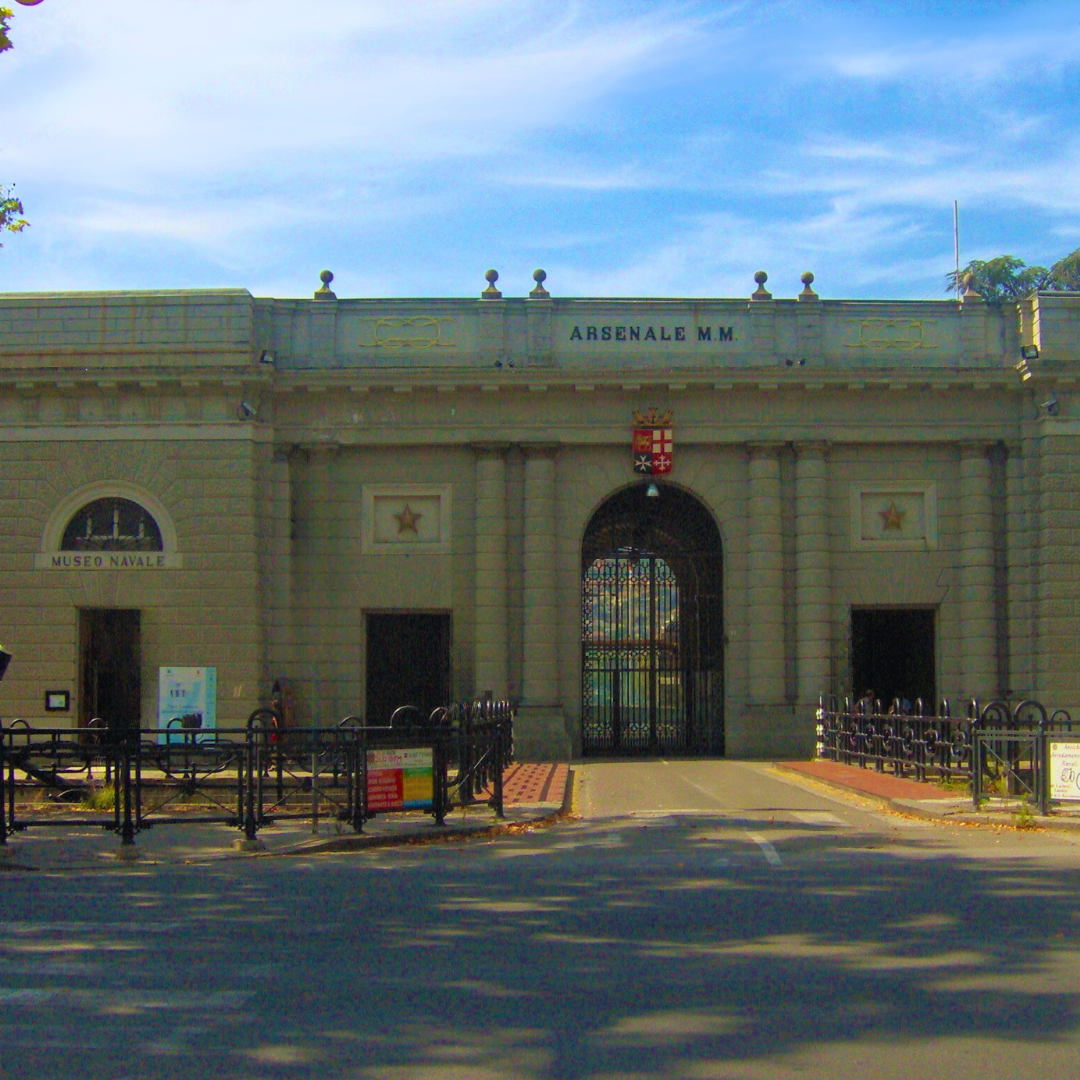
The La Spezia Naval Military Arsenal is located in the central-western area of the Gulf of La Spezia, right next to the historic city center. It covers an area of almost 90 hectares and contains about 13 kilometers of roads within its premises.
At the main entrance of the arsenal is the Naval Technical Museum, which is regularly open to the public and was established to keep the traditions of seafaring alive.
After an initial arsenal was built in the city in the 15th century for the galleys of the Sforza family, it was Napoleon Bonaparte who reconsidered the possibility of building a modern arsenal in the Gulf of La Spezia. Andrea Tagliafichi was tasked with the project, but it was never realized.
The idea of the Arsenal was revived in 1857 by Cavour, then President of the Council and Minister of the Navy, who sought the necessary funds and entrusted Domenico Chiodo, an officer of the Military Engineering Corps, with the construction of the new Italian naval base. The project profoundly impacted the La Spezia area: from the disappearance of the ancient “sprugole” (sinkholes where water used to disappear) to the removal of entire inhabited centers, the Arsenal and the related military areas completely occupied the valley overlooking the Gulf of La Spezia.
Construction began in 1862 and was completed on August 28, 1869, when General Domenico Chiodo formally inaugurated the not-yet-finished facility by flooding the newly built basins.
To protect the Arsenal and the naval base, the system of forts on the ridges of the gulf was expanded. During the works, Roman and early medieval remains were found and almost entirely destroyed. The Roman past of the area is practically unknown to the public.
During World War II, it was the site of the 2nd squadron and the 10th MAS flotilla, among other units. Due to its strategic importance, the arsenal was heavily damaged but quickly restored to operational status in the immediate post-war period.
In the post-war period and throughout the Cold War, the arsenal hosted the 1st naval division, employing about 12,000 civilian workers in its workshops.
The fall of the Berlin Wall and the end of the Cold War changed defense needs, shifting interest towards the south, in the Mediterranean. This led to a significant loss of importance for the La Spezia base in favor of those in Taranto and Augusta.
Another challenge for the arsenal is the inability to maintain adequate confidentiality: the interior of the arsenal is perfectly visible from the houses adjacent to its perimeter and from the mountains on the western side of the gulf, although modern technologies have made these security measures outdated.
In 1951, the La Spezia Arsenal had over 12,000 civilian employees. In 2023, it had 390.
In 2022, the Navy Engineering Corps initiated the procedure to upgrade the base to NATO standards, including a project to expand the Darsena Duca degli Abruzzi, in front of the village of Marola, and the extension of the only pier currently designated for NATO units. This project is part of the Blue Bases program.
Today, the La Spezia Naval Military Arsenal represents a collaboration and synergy with local authorities and industry for the development of important scientific, technological, and social projects.
The military arsenal can be visited for free only during the celebrations of Saint Joseph, the city’s patron saint. By staying at Downtown Blue Apartment, you can visit some of the ships moored at the docks inside the Arsenal and some structures of the Navy.