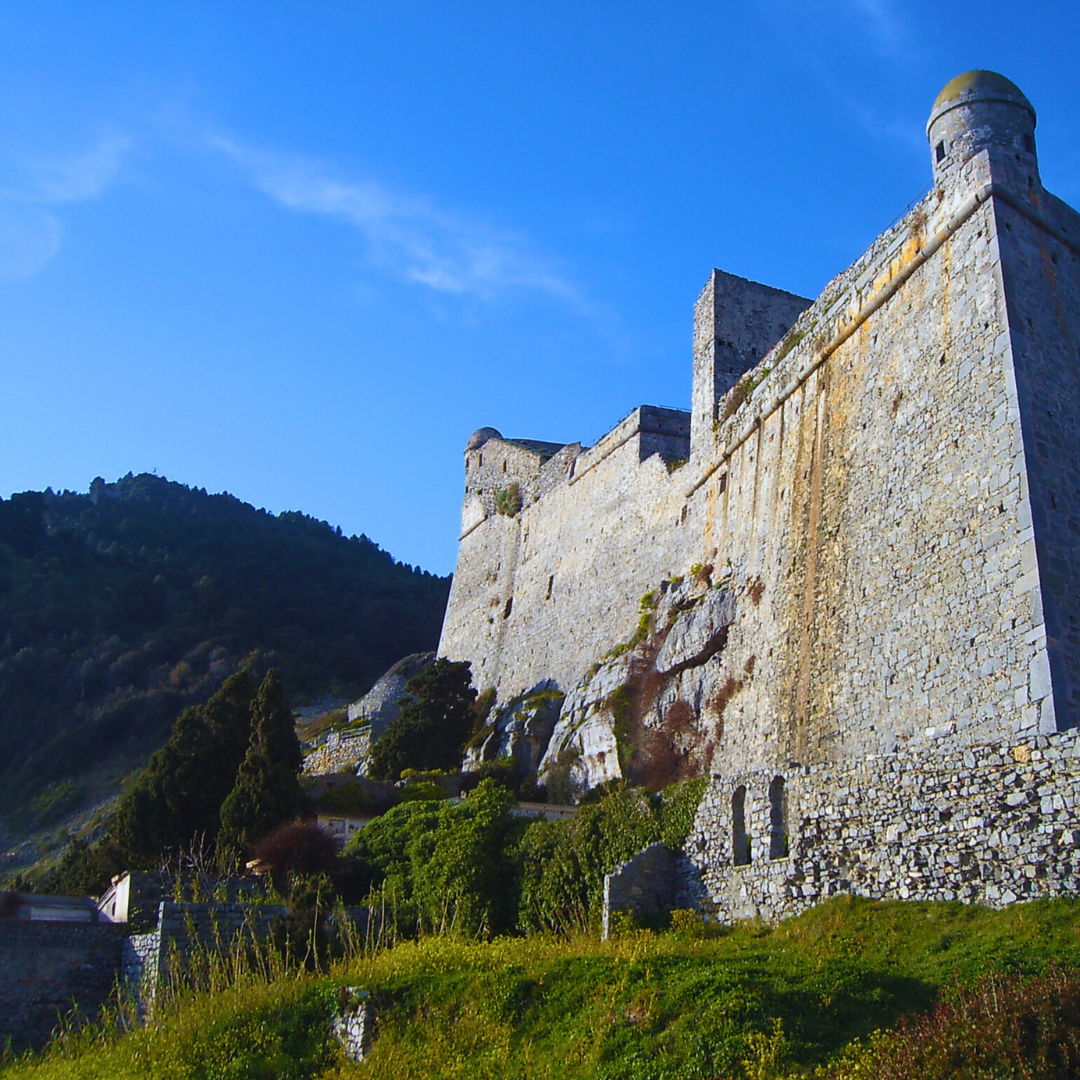
Doria Castle is a fortress located on the rocky height overlooking the seaside village of Portovenere (SP), from where you can enjoy a breathtaking view of the entire Gulf of Poets.
Considered one of the most majestic military structures of the Republic of Genoa in the eastern Ligurian region, it is accessible by following the road leading to the castle.
The first fortified nucleus stood adjacent to the Church of San Pietro, though it’s difficult to determine the exact date of its construction. What we do know is that the castle was later rebuilt in an even more strategic location, offering a more commanding view than its predecessor. It was at the center of numerous conflicts between Genoa and Pisa, and in 1139 the Republic of Genoa, through the Lords of Vezzano, managed to conquer it along with the village of Portovenere.
In the 13th century, the fortress was again at the center of the struggles between Genoa and Pisa for control over the surrounding lands. Around the mid-century, both the castle and the fishing village of Portovenere became part of the vast feudal holdings in eastern Liguria of Nicolò Fieschi, before returning to Genoese control in 1276. Over the centuries, under various rulers, the fortress underwent several modifications and expansions, but it wasn’t until the 17th century that it took on its current appearance.
During the Napoleonic domination of the Ligurian Republic at the beginning of the 19th century, the building was used as a prison, although this did not alter its architectural features.
Today, the ancient Genoese fortress is owned by the Municipality of Portovenere and, following a meticulous restoration in the 1970s, it now hosts art exhibitions and various cultural events throughout the year.
The fortress has a pentagonal layout with three bastions and a solid circular tower, which was already part of the medieval castle. Access to the fortress originally occurred via a drawbridge, which no longer exists; today, entry is through a grand portal. From the castle, a defensive wall with slits, walkways, and towers descends to enclose the village of Portovenere.
In the wall, at the entrance gate to the village, stands the Capitular Tower, built in 1161, featuring openings adorned with biforas and triforas (typical twin and triple-arched windows). To the left of the entrance are two Genoese volumetric measures once used for trading cereals, salt, and other goods.
By staying at Downtown Blue Apartment, you can reach Doria Castle in just a few minutes by bus and take a step back in time to explore its rich history, culture, and natural beauty.